What is the educational platform? A simplified guide for schools and teachers
ففريق كرافتا··8 min read
The educational platform has become one of the most important tools that schools and teachers rely on to organize the educational process inside and outside the classroom. With the rapid development of digital education, the question is no longer: Do we need a platform? Rather, it has become: What is the truly appropriate educational platform that helps the school and teacher manage content, activities, tests, and follow-up in a clear and easy way? Therefore, if you are looking for the definition of an educational platform or want to understand the role of educational platforms in schools in a simplified way, this guide will explain the idea to you from the ground up.
What is the educational platform?
When talking about what an educational platform is, it can simply be defined as a digital system that helps manage and organize learning from one place. The platform may allow the teacher to upload content, create classes, distribute assignments, prepare tests, monitor student performance, and communicate with them more easily.
In other words, the educational platform is not just a site for displaying lessons, but rather an integrated environment that facilitates the educational process and connects the student, teacher, and administration within one space.
Definition of the educational platform in a simple way
If we want to present the definition of the educational platform in a direct way, it can be said that it is:
A digital tool for organizing learning
A space that brings together the teacher and student within one environment
A means of presenting lessons, activities and assessments
A system that helps monitor performance and interaction
This definition is important; Because many people think that educational platforms are limited only to uploading files or watching videos, while their real role is much greater than that.
Why do schools need an educational platform?
The educational platform has become an essential element in modern schools for several reasons, the most important of which are:
Organizing educational content in an easier way
Facilitating communication between teacher and student
Raising the level of interaction within the educational process
Follow up on assignments and tests more closely
Providing reports that help measure performance
Supporting digital transformation in the school
Therefore, having an educational platform within the school is no longer a luxury, but rather an important part of developing the learning environment and improving the student and teacher experience together.
What do educational platforms offer teachers?
One of the most important benefits that educational platforms offer to teachers is that they reduce manual effort and help organize daily work better. Through the platform, the teacher can:
Create a digital classroom
Uploading lessons and educational materials
Preparing tests and activities
Follow up on students' progress
Review results and reports
Managing classroom interaction
In this way, the educational platform turns into a tool that helps the teacher focus more on the quality of teaching instead of being busy with routine work.
What does the educational platform offer students?
The student also benefits greatly from having a clear and easy learning platform, because it gives him:
Organized access to lessons
Review content at any time
Participate in activities and tests
Monitor his level and progress
A more interactive and stimulating environment
The more the educational platform is designed in a comfortable and interactive way, the greater the chance that the student will relate to the content and interact better with the lesson.
What is the difference between the traditional educational platform and the interactive educational platform?
Not all educational platforms are at the same level. Some platforms only display content, while there are other platforms that care about interaction, motivation, and smart follow-up.
The traditional platform often focuses on:
Upload files
View lessons
Essentially executing tasks
The interactive educational platform focuses on:
Interaction within the class
Educational activities
Smart tests
Detailed reports
Motivation and gamification
Improving the student and teacher experience
Here the real difference between just a content management system and an educational platform that actually contributes to the development of learning appears.
What characteristics should a good educational platform have?
When choosing an educational platform for a school or teacher, there are a set of important characteristics that you should pay attention to, such as:
Ease of use
Arabic language support
Create classes and manage students
Tests and assignments
Reports and follow-up
Interaction within the class
Artificial intelligence support
The presence of stimulating activities for students
The more these elements are available, the better the educational platform is able to support the educational environment and achieve better results.
How does the educational platform help increase engagement?
One of the biggest challenges facing schools and teachers today is poor engagement, especially when the learning experience is dry or traditional. Here comes the importance of the educational platform that provides:
Live activities
Interactive tests
Stimulating elements
Continuous follow-up
Tools that encourage student participation
For this reason, schools are looking not just for any platform, but for a learning platform that makes learning more lively and easier to follow.
After understanding what an educational platform is and what it has to offer, Cravta can be viewed as an example of an interactive educational platform that combines a number of elements that schools and teachers need today, such as:
Classrooms
Educational activities
Tests
Reports
Artificial intelligence tools
Interaction and stimulation
Cravta's mention here does not come as a direct announcement, but rather as a practical model that explains how the educational platform can transform from a mere place to display content into an integrated educational environment that supports modern learning.
How does the school choose the appropriate educational platform?
Before participating in any educational platform, it is best to ask the school or teacher the following questions:
Is the platform easy to use?
Do you support both teacher and student?
Do you provide tests and activities?
Do you provide clear reports?
Do you support Arabic language?
Does it enhance classroom interaction?
Does it contain modern tools such as artificial intelligence?
These questions help to better evaluate educational platforms, and choose the solution that serves the school practically, not just formally.
Conclusion
Understanding what an educational platform is is the first step before choosing the right solution for your school or teacher. A good platform is not just a tool for presenting lessons, but rather an integrated system that helps organize learning, increase interaction, monitor performance, and support the educational process in a more flexible and modern way.
With the diversity of educational platforms today, preference becomes for solutions that combine ease of use, interaction, reporting, and the ability to keep pace with modern education. Here, Cravta can be seen as one of the examples that illustrates how the educational platform can work in an integrated manner that serves students, teachers, and schools in a more effective digital environment.
Frequently asked questions
What is the educational platform?
The educational platform is a digital system that helps manage learning by displaying lessons, activities, tests, and monitoring student performance.
What is the definition of an educational platform?
The definition of an educational platform is that it is an electronic environment that brings together the teacher, student, and content within one system that facilitates the management of the educational process.
Why do schools need an educational platform?
Because it helps organize lessons, facilitate follow-up, increase interaction, and improve the learning experience within the school.
What is the difference between an educational platform and an interactive platform?
The interactive platform offers broader tools for participation, motivation, activities, and tests, while some traditional platforms only display content.
Are all educational platforms suitable for schools?
Not necessarily, because schools need an educational platform that suits the nature of their students and teachers and supports the Arabic language, reports, and ease of use.
Is Cravta considered an educational platform?
Yes, Cravta can be considered an example of an interactive learning platform that combines classes, activities, quizzes, reports, and AI tools in one environment.




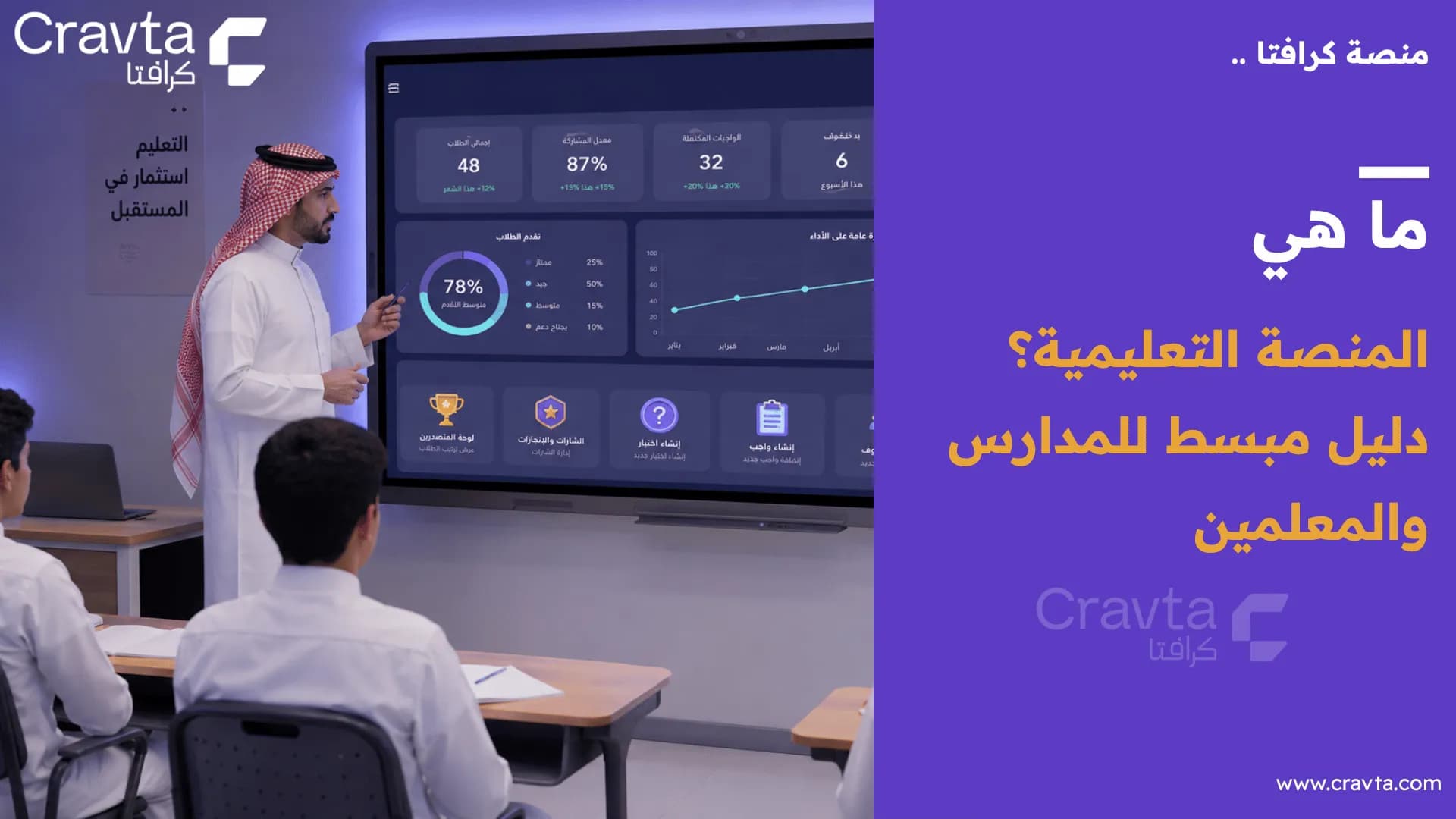
The educational platform has become one of the most important tools that schools and teachers rely on to organize the educational process inside and outside the classroom. With the rapid development of digital education, the question is no longer: Do we need a platform? Rather, it has become: What is the truly appropriate educational platform that helps the school and teacher manage content, activities, tests, and follow-up in a clear and easy way? Therefore, if you are looking for the definition of an educational platform or want to understand the role of educational platforms in schools in a simplified way, this guide will explain the idea to you from the ground up.
What is the educational platform?
When talking about what an educational platform is, it can simply be defined as a digital system that helps manage and organize learning from one place. The platform may allow the teacher to upload content, create classes, distribute assignments, prepare tests, monitor student performance, and communicate with them more easily.
In other words, the educational platform is not just a site for displaying lessons, but rather an integrated environment that facilitates the educational process and connects the student, teacher, and administration within one space.
Definition of the educational platform in a simple way
If we want to present the definition of the educational platform in a direct way, it can be said that it is:
A digital tool for organizing learning
A space that brings together the teacher and student within one environment
A means of presenting lessons, activities and assessments
A system that helps monitor performance and interaction
This definition is important; Because many people think that educational platforms are limited only to uploading files or watching videos, while their real role is much greater than that.
Why do schools need an educational platform?
The educational platform has become an essential element in modern schools for several reasons, the most important of which are:
Organizing educational content in an easier way
Facilitating communication between teacher and student
Raising the level of interaction within the educational process
Follow up on assignments and tests more closely
Providing reports that help measure performance
Supporting digital transformation in the school
Therefore, having an educational platform within the school is no longer a luxury, but rather an important part of developing the learning environment and improving the student and teacher experience together.
What do educational platforms offer teachers?
One of the most important benefits that educational platforms offer to teachers is that they reduce manual effort and help organize daily work better. Through the platform, the teacher can:
Create a digital classroom
Uploading lessons and educational materials
Preparing tests and activities
Follow up on students' progress
Review results and reports
Managing classroom interaction
In this way, the educational platform turns into a tool that helps the teacher focus more on the quality of teaching instead of being busy with routine work.
What does the educational platform offer students?
The student also benefits greatly from having a clear and easy learning platform, because it gives him:
Organized access to lessons
Review content at any time
Participate in activities and tests
Monitor his level and progress
A more interactive and stimulating environment
The more the educational platform is designed in a comfortable and interactive way, the greater the chance that the student will relate to the content and interact better with the lesson.
What is the difference between the traditional educational platform and the interactive educational platform?
Not all educational platforms are at the same level. Some platforms only display content, while there are other platforms that care about interaction, motivation, and smart follow-up.
The traditional platform often focuses on:
Upload files
View lessons
Essentially executing tasks
The interactive educational platform focuses on:
Interaction within the class
Educational activities
Smart tests
Detailed reports
Motivation and gamification
Improving the student and teacher experience
Here the real difference between just a content management system and an educational platform that actually contributes to the development of learning appears.
What characteristics should a good educational platform have?
When choosing an educational platform for a school or teacher, there are a set of important characteristics that you should pay attention to, such as:
Ease of use
Arabic language support
Create classes and manage students
Tests and assignments
Reports and follow-up
Interaction within the class
Artificial intelligence support
The presence of stimulating activities for students
The more these elements are available, the better the educational platform is able to support the educational environment and achieve better results.
How does the educational platform help increase engagement?
One of the biggest challenges facing schools and teachers today is poor engagement, especially when the learning experience is dry or traditional. Here comes the importance of the educational platform that provides:
Live activities
Interactive tests
Stimulating elements
Continuous follow-up
Tools that encourage student participation
For this reason, schools are looking not just for any platform, but for a learning platform that makes learning more lively and easier to follow.
Where does Cravta appear in this context?
After understanding what an educational platform is and what it has to offer, Cravta can be viewed as an example of an interactive educational platform that combines a number of elements that schools and teachers need today, such as:
Classrooms
Educational activities
Tests
Reports
Artificial intelligence tools
Interaction and stimulation
Cravta's mention here does not come as a direct announcement, but rather as a practical model that explains how the educational platform can transform from a mere place to display content into an integrated educational environment that supports modern learning.
How does the school choose the appropriate educational platform?
Before participating in any educational platform, it is best to ask the school or teacher the following questions:
Is the platform easy to use?
Do you support both teacher and student?
Do you provide tests and activities?
Do you provide clear reports?
Do you support Arabic language?
Does it enhance classroom interaction?
Does it contain modern tools such as artificial intelligence?
These questions help to better evaluate educational platforms, and choose the solution that serves the school practically, not just formally.
Conclusion
Understanding what an educational platform is is the first step before choosing the right solution for your school or teacher. A good platform is not just a tool for presenting lessons, but rather an integrated system that helps organize learning, increase interaction, monitor performance, and support the educational process in a more flexible and modern way.
With the diversity of educational platforms today, preference becomes for solutions that combine ease of use, interaction, reporting, and the ability to keep pace with modern education. Here, Cravta can be seen as one of the examples that illustrates how the educational platform can work in an integrated manner that serves students, teachers, and schools in a more effective digital environment.
Frequently asked questions
What is the educational platform?
The educational platform is a digital system that helps manage learning by displaying lessons, activities, tests, and monitoring student performance.
What is the definition of an educational platform?
The definition of an educational platform is that it is an electronic environment that brings together the teacher, student, and content within one system that facilitates the management of the educational process.
Why do schools need an educational platform?
Because it helps organize lessons, facilitate follow-up, increase interaction, and improve the learning experience within the school.
What is the difference between an educational platform and an interactive platform?
The interactive platform offers broader tools for participation, motivation, activities, and tests, while some traditional platforms only display content.
Are all educational platforms suitable for schools?
Not necessarily, because schools need an educational platform that suits the nature of their students and teachers and supports the Arabic language, reports, and ease of use.
Is Cravta considered an educational platform?
Yes, Cravta can be considered an example of an interactive learning platform that combines classes, activities, quizzes, reports, and AI tools in one environment.
Explore these related topics: the best interactive educational platform, e-learning platforms, Saudi educational platforms.
You may also like
The best interactive educational platform for schools in Saudi Arabia: selection criteria before subscribing
E-learning platform or interactive learning platform? The difference that matters to the school
Saudi educational platform: Why do schools need a local solution for interactive education?
Your next step: Learn more about the Cravta learning platform, browse Cravta articles, then create your account to build a more interactive learning experience.