E-learning platform or interactive learning platform? The difference that matters to the school
ففريق كرافتا··7 min read
When looking for an e-learning platform, some schools may think that all digital educational solutions serve the same purpose, but the reality is very different. There is a clear difference between a platform that merely displays content and assignments, and a platform that builds a real learning experience based on interactive education. Therefore, understanding the difference between an e-learning platform and an interactive learning platform has become very important for any school that wants to make the right decision before subscribing to any digital system.
What is meant by e-learning platform?
An e-learning platform is a digital system that allows a school or teacher to deliver educational content online. These platforms often include features such as:
Upload lessons
File sharing
Submit assignments
Organizing classes
Conduct basic tests
Follow up on some educational aspects
This type of platform is definitely useful, especially for organizing content and accessing it from anywhere. But in many cases it remains more of a learning management tool than a fully interactive environment.
What is interactive learning?
As for interactive education, it is a method that relies on making the student an actual part of the educational process, not just a recipient of information. In interactive learning, it is not limited to just presenting the lesson, but also includes:
Instant sharing
Challenges and activities
Direct tests
Quick feedback
Motivation and competition
Close monitoring of performance
Therefore, an interactive educational platform is not limited to delivering content, but rather aims to raise interaction, increase participation, and improve the learning experience in a practical way.
The difference between e-learning and interactive education
When comparing the e-learning platform and interactive education, we find that the main difference is not only in the presence of technology, but in the way technology is used within learning.
An e-learning platform often focuses on:
Organizing lessons
Content storage
Distribution of duties
Executing basic tests
Manage access to content
The interactive educational platform focuses on:
Involving the student in the lesson
Create a stimulating learning environment
Provide live tests
Support challenges and activities
Raising motivation through motivation
Giving the teacher a clearer vision of interaction and performance
So, the difference is not only related to the name, but rather to the quality of the educational experience that the platform provides.
Why does this school difference matter?
Some schools may ask: What's the problem if the e-learning platform regulates content and tests? The problem is not organization, but rather that schools today need more than just archiving lessons. You need:
Increase student engagement
Reduce boredom
Increase their engagement with the content
Support the teacher with clearer data
Providing tools that make learning more vibrant
This is where the real difference comes in: If a school just wants a content management system, a traditional solution may suffice. If it wants to improve the educational experience itself, it needs an interactive educational platform.
When is an e-learning platform not enough?
In some cases, an e-learning platform alone may not be sufficient, such as:
When students are poorly interactive
When the teacher needs additional motivational tools
When the school wants to increase classroom participation
When detailed performance monitoring is necessary
When the administration wants a clearer view of students’ behavior and progress
In these cases, it is not enough for the student to just see the content; Rather, he must live a more active learning experience, and this is what interactive education provides best.
What does the interactive educational platform add to the school?
A school that adopts an interactive learning platform often gains benefits beyond just content management, such as:
Live tests in class
Educational activities and challenges
Clearer reporting of interaction and results
Tools that motivate students to participate
A more flexible and modern learning experience
All of these elements make the platform part of the school's development itself, and not just a file management side program.
When explaining the difference between an e-learning platform and an interactive learning platform, Cravta can be cited as an example of a platform that goes beyond simply displaying content. Crafta does not only serve as a platform for uploading lessons or organizing classes, but also supports more interactive elements such as:
Educational challenges
Direct tests
Detailed reports
Flash cards
Leaderboards
Motivation and gamification elements
This makes it closer to an interactive educational platform that serves the school from the standpoint of interaction, follow-up, and motivation, not just from the standpoint of displaying content.
Why is interactive learning more important today?
Students today deal with a digital environment that is fast and full of stimuli, so being satisfied with static content within the e-learning platform may not be enough to maintain their attention. As for interactive education, it provides them with an experience closer to the learning style that suits them today, through:
Share
Challenges
Achievement
Positive competition
Fast reaction
That is why the school needs a platform that keeps pace with this change, instead of just digitizing traditional content.
How does a school know that it needs an interactive platform?
The school can ask itself these questions:
Are students actually engaging with the content or just watching?
Does the teacher need more tools than uploading lessons?
Do we need deeper performance reporting?
Are we looking for real motivation for students?
Do we want a more engaging and clearer learning experience?
If the answer is yes to more than one question, then most likely the school does not only need an e-learning platform, but rather an interactive educational platform.
Is interactive always best?
The point here is not that every e-learning platform is weak, nor that every interactive platform is automatically suitable. The school needs to choose according to its needs, but it is important to realize the difference:
If the goal is simply to organize content, a traditional system may suffice.
If the goal is to develop interaction, learning, and follow-up, the interactive solution is more beneficial.
Therefore, the correct question is not: Which is absolutely better? Rather: Which one is more suitable for the school’s needs?
Conclusion
The difference between the e-learning platform and the interactive learning platform is a very important difference for schools that want to develop their educational experience, not just digitize lessons. The traditional electronic platform may organize the content and facilitate access to it, but interactive education adds elements of participation, motivation, direct tests, reports, and careful follow-up.
Therefore, a school that wants a more lively and interactive environment is not enough to just ask about an e-learning platform, but rather it must look for an interactive educational platform capable of providing a more advanced educational experience. Here, Cravta can be seen as a model that applies this trend through challenges, live quizzes, reports, flash cards, and leaderboards, making it more than just a content display platform.
Frequently asked questions
What is an e-learning platform?
It is a digital platform that helps provide lessons, assignments, tests, and organize learning online.
What is the difference between e-learning and interactive education?
E-learning mostly focuses on content management, while interactive learning focuses on engaging the student more in the educational experience.
Is every e-learning platform considered an interactive platform?
No, some platforms merely display content and manage assignments, while interactive platforms offer deeper activities, tests, motivation, and follow-up.
Why does the school need an interactive educational platform?
Because it helps increase student engagement, improve follow-up, and provide a more effective learning experience than simply displaying content.
What distinguishes Cravta in this aspect?
Cravta offers interactive elements like challenges, live quizzes, reports, flash cards, and leaderboards, so it doesn't just serve as a content display platform.
Is interactive education suitable for all schools?
Yes, especially for schools that want to improve classroom interaction, develop the learning experience, and monitor student performance more clearly.




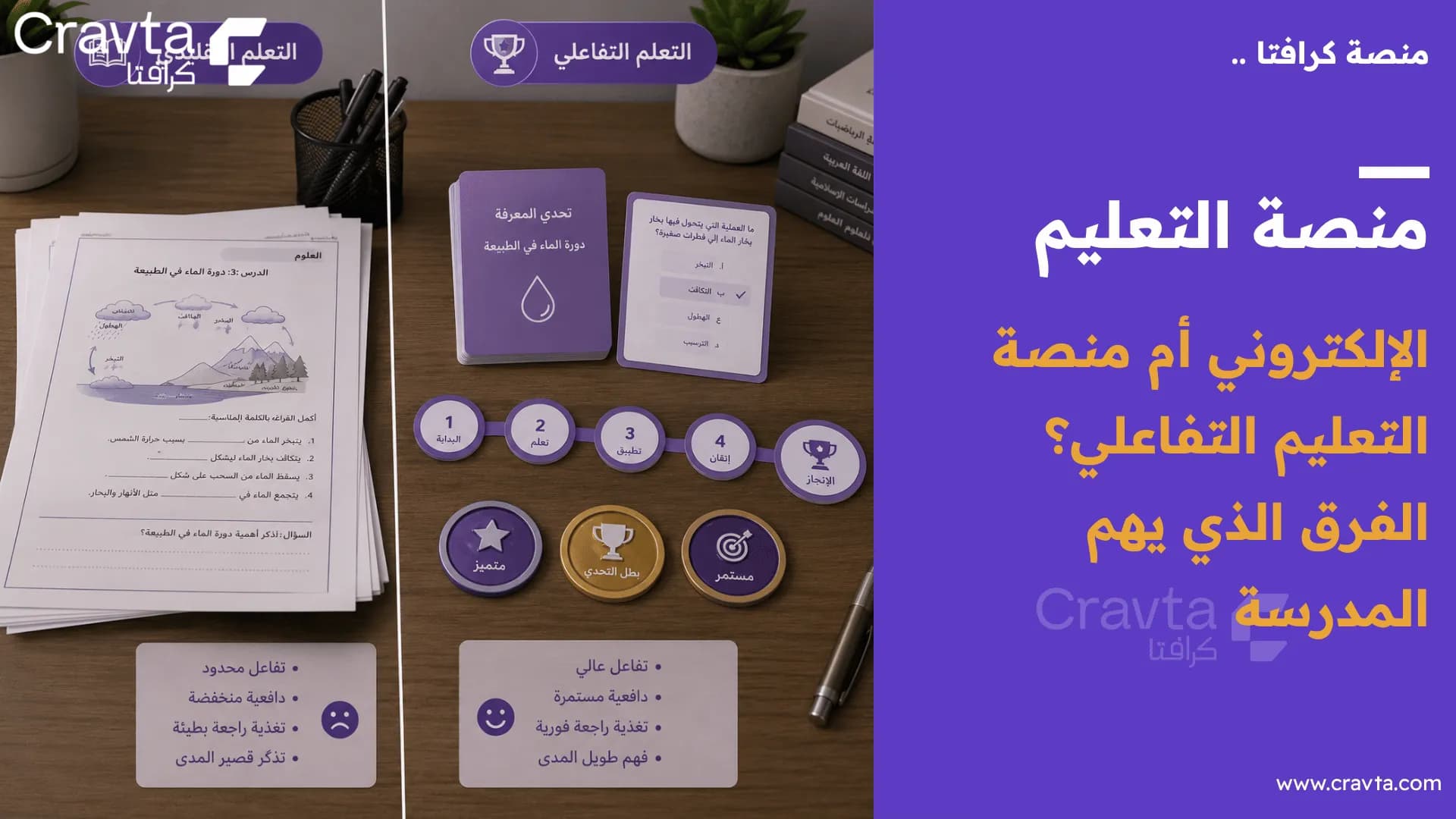
When looking for an e-learning platform, some schools may think that all digital educational solutions serve the same purpose, but the reality is very different. There is a clear difference between a platform that merely displays content and assignments, and a platform that builds a real learning experience based on interactive education. Therefore, understanding the difference between an e-learning platform and an interactive learning platform has become very important for any school that wants to make the right decision before subscribing to any digital system.
What is meant by e-learning platform?
An e-learning platform is a digital system that allows a school or teacher to deliver educational content online. These platforms often include features such as:
Upload lessons
File sharing
Submit assignments
Organizing classes
Conduct basic tests
Follow up on some educational aspects
This type of platform is definitely useful, especially for organizing content and accessing it from anywhere. But in many cases it remains more of a learning management tool than a fully interactive environment.
What is interactive learning?
As for interactive education, it is a method that relies on making the student an actual part of the educational process, not just a recipient of information. In interactive learning, it is not limited to just presenting the lesson, but also includes:
Instant sharing
Challenges and activities
Direct tests
Quick feedback
Motivation and competition
Close monitoring of performance
Therefore, an interactive educational platform is not limited to delivering content, but rather aims to raise interaction, increase participation, and improve the learning experience in a practical way.
The difference between e-learning and interactive education
When comparing the e-learning platform and interactive education, we find that the main difference is not only in the presence of technology, but in the way technology is used within learning.
An e-learning platform often focuses on:
Organizing lessons
Content storage
Distribution of duties
Executing basic tests
Manage access to content
The interactive educational platform focuses on:
Involving the student in the lesson
Create a stimulating learning environment
Provide live tests
Support challenges and activities
Raising motivation through motivation
Giving the teacher a clearer vision of interaction and performance
So, the difference is not only related to the name, but rather to the quality of the educational experience that the platform provides.
Why does this school difference matter?
Some schools may ask: What's the problem if the e-learning platform regulates content and tests? The problem is not organization, but rather that schools today need more than just archiving lessons. You need:
Increase student engagement
Reduce boredom
Increase their engagement with the content
Support the teacher with clearer data
Providing tools that make learning more vibrant
This is where the real difference comes in: If a school just wants a content management system, a traditional solution may suffice. If it wants to improve the educational experience itself, it needs an interactive educational platform.
When is an e-learning platform not enough?
In some cases, an e-learning platform alone may not be sufficient, such as:
When students are poorly interactive
When the teacher needs additional motivational tools
When the school wants to increase classroom participation
When detailed performance monitoring is necessary
When the administration wants a clearer view of students’ behavior and progress
In these cases, it is not enough for the student to just see the content; Rather, he must live a more active learning experience, and this is what interactive education provides best.
What does the interactive educational platform add to the school?
A school that adopts an interactive learning platform often gains benefits beyond just content management, such as:
Live tests in class
Educational activities and challenges
Clearer reporting of interaction and results
Tools that motivate students to participate
A more flexible and modern learning experience
All of these elements make the platform part of the school's development itself, and not just a file management side program.
Where does Cravta figure in this difference?
When explaining the difference between an e-learning platform and an interactive learning platform, Cravta can be cited as an example of a platform that goes beyond simply displaying content. Crafta does not only serve as a platform for uploading lessons or organizing classes, but also supports more interactive elements such as:
Educational challenges
Direct tests
Detailed reports
Flash cards
Leaderboards
Motivation and gamification elements
This makes it closer to an interactive educational platform that serves the school from the standpoint of interaction, follow-up, and motivation, not just from the standpoint of displaying content.
Why is interactive learning more important today?
Students today deal with a digital environment that is fast and full of stimuli, so being satisfied with static content within the e-learning platform may not be enough to maintain their attention. As for interactive education, it provides them with an experience closer to the learning style that suits them today, through:
Share
Challenges
Achievement
Positive competition
Fast reaction
That is why the school needs a platform that keeps pace with this change, instead of just digitizing traditional content.
How does a school know that it needs an interactive platform?
The school can ask itself these questions:
Are students actually engaging with the content or just watching?
Does the teacher need more tools than uploading lessons?
Do we need deeper performance reporting?
Are we looking for real motivation for students?
Do we want a more engaging and clearer learning experience?
If the answer is yes to more than one question, then most likely the school does not only need an e-learning platform, but rather an interactive educational platform.
Is interactive always best?
The point here is not that every e-learning platform is weak, nor that every interactive platform is automatically suitable. The school needs to choose according to its needs, but it is important to realize the difference:
If the goal is simply to organize content, a traditional system may suffice.
If the goal is to develop interaction, learning, and follow-up, the interactive solution is more beneficial.
Therefore, the correct question is not: Which is absolutely better? Rather: Which one is more suitable for the school’s needs?
Conclusion
The difference between the e-learning platform and the interactive learning platform is a very important difference for schools that want to develop their educational experience, not just digitize lessons. The traditional electronic platform may organize the content and facilitate access to it, but interactive education adds elements of participation, motivation, direct tests, reports, and careful follow-up.
Therefore, a school that wants a more lively and interactive environment is not enough to just ask about an e-learning platform, but rather it must look for an interactive educational platform capable of providing a more advanced educational experience. Here, Cravta can be seen as a model that applies this trend through challenges, live quizzes, reports, flash cards, and leaderboards, making it more than just a content display platform.
Frequently asked questions
What is an e-learning platform?
It is a digital platform that helps provide lessons, assignments, tests, and organize learning online.
What is the difference between e-learning and interactive education?
E-learning mostly focuses on content management, while interactive learning focuses on engaging the student more in the educational experience.
Is every e-learning platform considered an interactive platform?
No, some platforms merely display content and manage assignments, while interactive platforms offer deeper activities, tests, motivation, and follow-up.
Why does the school need an interactive educational platform?
Because it helps increase student engagement, improve follow-up, and provide a more effective learning experience than simply displaying content.
What distinguishes Cravta in this aspect?
Cravta offers interactive elements like challenges, live quizzes, reports, flash cards, and leaderboards, so it doesn't just serve as a content display platform.
Is interactive education suitable for all schools?
Yes, especially for schools that want to improve classroom interaction, develop the learning experience, and monitor student performance more clearly.
Explore these related topics: virtual and interactive classrooms, the best interactive educational platform, what an educational platform is.
You may also like
Virtual classroom or interactive classroom? The difference that matters to schools and teachers
The best interactive educational platform for schools in Saudi Arabia: selection criteria before subscribing
What is the educational platform? A simplified guide for schools and teachers
Your next step: Learn more about the Cravta learning platform, browse Cravta articles, then create your account to build a more interactive learning experience.