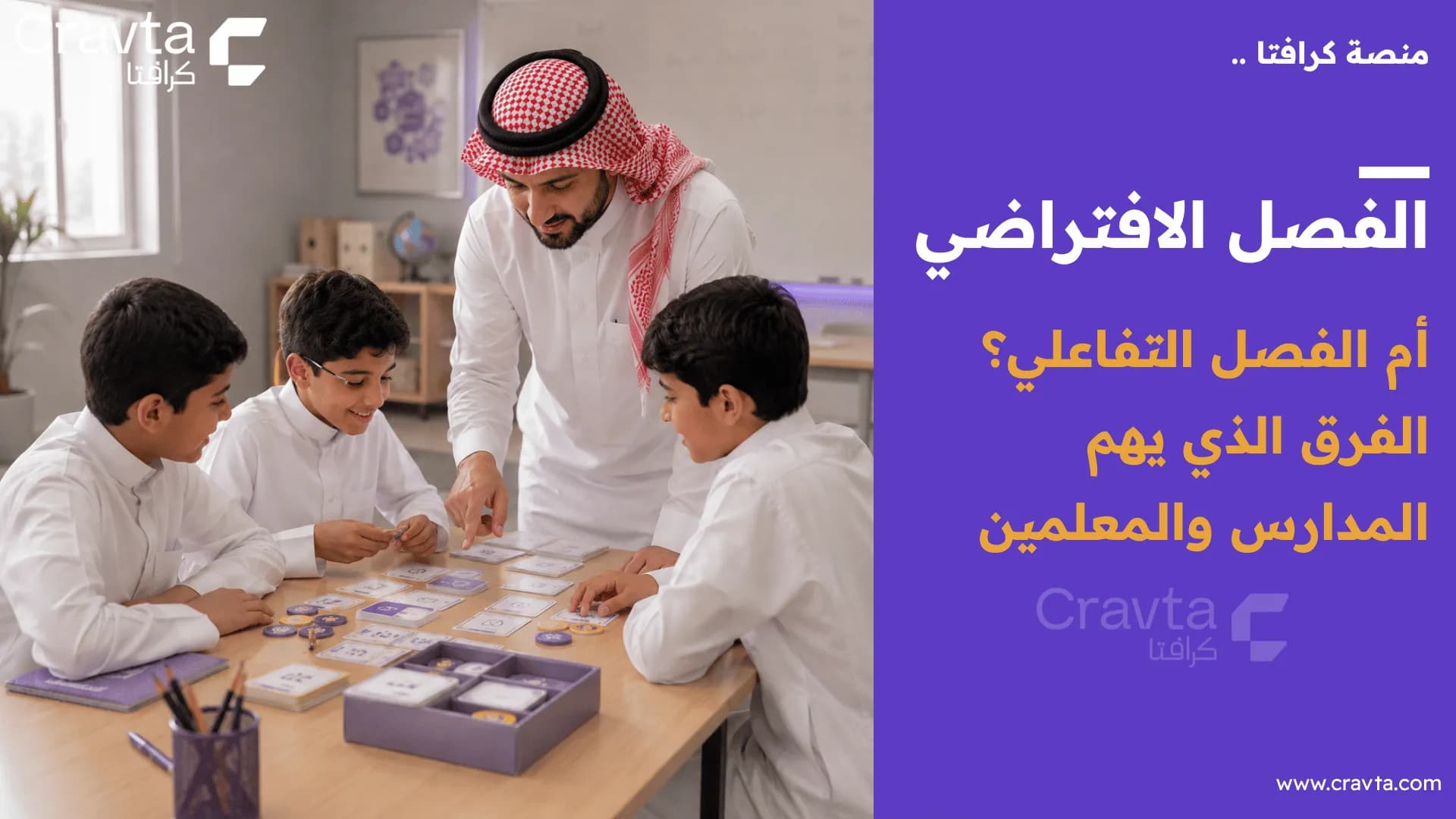
Virtual classroom or interactive classroom? The difference that matters to schools and teachers
ففريق كرافتا··8 min read
The virtual classroom has become a common term in modern education, especially after schools expanded the use of digital solutions and online learning management. But with the increased reliance on technology in education, an important question has begun to emerge: Is it enough to have only a virtual class, or does the school need more than that? Here the real difference appears between the virtual classroom as a digital space for attendance and display of content, and the interactive classroom that turns learning into an experience based on participation, questions, activities, tests, and continuous follow-up.
What is a virtual classroom?
The virtual classroom can be simply defined as a digital environment that allows the teacher and students to meet inside an electronic space alternative to the traditional classroom. This type of classroom is often used in:
Explanation of distance learning lessons
Uploading educational materials
Share links and files
Carrying out some assignments or tests
Organizing communication between the teacher and students
This means that the virtual classroom represents an important step in digital education, because it helps the educational process continue outside the boundaries of the traditional place.
What is an interactive classroom?
The interactive classroom is a more advanced stage than just digital presence. In this type of class, the student is not only present, but becomes an actual participant in the learning by:
Direct questions
Challenges
Interactive activities
Instant tests
Feedback
Continuous monitoring of performance
In other words, the interactive classroom does not simply move the class to the Internet, but rather works to redesign the educational experience itself in a way that encourages interaction, attention, and participation.
The difference between the virtual classroom and the interactive classroom
The difference between a virtual classroom and an interactive classroom is not just about the form, but rather about the essence of the educational experience.
The virtual classroom often focuses on:
Students attend digitally
Display content
File sharing
Implementing lessons remotely
Manage essential duties and tasks
The interactive chapter focuses on:
Involve the student at every stage of the lesson
Make learning participatory
Measure understanding in real time
Raising students' motivation
Turn the class into a more lively experience
Therefore, schools and teachers who want better results look not only at having a virtual class, but at the platform's ability to turn it into a real interactive class.
Why is the virtual classroom alone not enough in many cases?
In many schools, the virtual classroom may solve the problem of access to content, but it does not always solve the problem of:
Here the need for interactive education appears, because the goal is no longer just for the student to enter the digital classroom, but rather to interact within it, participate, and learn in a deeper and more active way.
Why is interactive classroom more important today?
Students today deal with an environment full of fast-paced stimuli, so simply sitting in front of a screen in a virtual classroom does not necessarily guarantee focus or understanding. The interactive classroom adds elements that make the student more engaged, such as:
Quick questions
Challenges
Direct evaluation
Feedback
Motivation and positive competition
These elements make the lesson more of a live experience, rather than just a broadcast or display of content.
What does the teacher benefit from the interactive classroom?
The teacher does not only need a digital place that brings together students, but also needs tools that help him:
Know who is participating and who is not
Measure understanding during the lesson
Provide live tests
Activate activities easily
Monitor performance more clearly
Improve class engagement without significant additional effort
Therefore, the interactive class gives the teacher a higher value than the traditional virtual class, because it supports him in managing the class more intelligently and flexibly.
What does the school benefit from switching to an interactive classroom?
When a school relies on interactive learning within its classrooms, it gains benefits that go beyond simply organizing digital attendance, such as:
Increase student engagement
Improving the quality of learning
Clarity of monitoring and evaluation
Reducing the gap between explanation and understanding
Giving the administration a better view of the performance of classes and teachers
Therefore, the difference between the virtual classroom and the interactive classroom is not only a technical difference, but a direct difference in the impact of the educational process itself.
How does a school know that it needs an interactive class and not just a virtual class?
The school can ask these questions:
Are students just attending or actually interacting?
Can understanding be measured during class?
Does the teacher have tools to activate the class?
Are there real-time tests and activities?
Can performance be monitored clearly after each lesson?
Does the student feel that he has a role within the class?
If these points are important to the school, then the need for an interactive class becomes greater than just having a virtual class.
When talking about the difference between a virtual classroom and an interactive classroom, Cravta can be mentioned as a model that shows how a classroom can be transformed from a digital-only presence to a more interactive learning experience. Not only does Crafta provide a space for classroom management, it helps support interactive learning through:
Questions within the class
Educational challenges
Direct tests
Performance tracking
Motivation and interaction tools
This makes it more of a platform that supports an interactive classroom than just an attendance or content display system.
Is it always best to have an interactive class?
In fact, the value of the virtual classroom is not to be underestimated, it is still important in organizing digital learning and delivering content. But when the school is looking for:
Increase the quality of experience
Increase interaction
Improve engagement
Clarity of results
Support the teacher during class
An interactive classroom would be better suited to this goal. Therefore, the question is not about which one is right and which one is wrong, but about which one is closer to the needs of the school today.
How does the school choose the appropriate platform?
Before choosing any platform for digital classes, it is best to ask the school:
Does the platform only offer a virtual class?
Or does it support an interactive class as well?
Can direct tests be performed?
Are there motivational tools for students?
Can performance be clearly tracked?
Does it help the teacher make the class more engaging?
The closer the platform is to these standards, the greater its ability to support the school.
Conclusion
The virtual classroom is an important step in digital education, but in many cases it is not enough alone to achieve an effective learning experience. Today, schools and teachers need more than a digital presence. They need tools that increase interaction, measure understanding, and encourage participation, and this is what the interactive classroom clearly provides.
Therefore, the difference between the virtual classroom and the interactive classroom is one that actually matters to the school when choosing the appropriate platform. When an educational institution searches for a solution that makes the class more lively, organized, and follow-up, it tends to solutions that support questions, challenges, tests, and performance tracking, such as the model offered by Cravta in transforming the classroom from a digital-only space into a more interactive and effective educational experience.
Frequently asked questions
What is a virtual classroom?
A virtual classroom is a digital space that brings together a teacher and students online to deliver lessons and share content and assignments.
What is an interactive classroom?
An interactive classroom is an educational environment that relies on student participation through questions, activities, tests, challenges, and continuous follow-up.
What is the difference between a virtual classroom and an interactive classroom?
The virtual classroom focuses on attendance and displaying content, while the interactive classroom focuses on participation, measuring understanding, and increasing interaction within the class.
Is virtual classroom enough for schools?
It may be sufficient in some basic cases, but it does not always achieve the level of interaction and follow-up that modern schools need.
Why has interactive learning become important for schools?
Because it helps improve student engagement, raise enthusiasm, strengthen understanding, and provide a more lively learning experience than the traditional method.
How does Cravta help in this aspect?
Cravta helps transform the classroom from a digital-only presence to a more interactive experience through questions, challenges, quizzes, and performance tracking inside and outside of class.




The virtual classroom has become a common term in modern education, especially after schools expanded the use of digital solutions and online learning management. But with the increased reliance on technology in education, an important question has begun to emerge: Is it enough to have only a virtual class, or does the school need more than that? Here the real difference appears between the virtual classroom as a digital space for attendance and display of content, and the interactive classroom that turns learning into an experience based on participation, questions, activities, tests, and continuous follow-up.
What is a virtual classroom?
The virtual classroom can be simply defined as a digital environment that allows the teacher and students to meet inside an electronic space alternative to the traditional classroom. This type of classroom is often used in:
Explanation of distance learning lessons
Uploading educational materials
Share links and files
Carrying out some assignments or tests
Organizing communication between the teacher and students
This means that the virtual classroom represents an important step in digital education, because it helps the educational process continue outside the boundaries of the traditional place.
What is an interactive classroom?
The interactive classroom is a more advanced stage than just digital presence. In this type of class, the student is not only present, but becomes an actual participant in the learning by:
Direct questions
Challenges
Interactive activities
Instant tests
Feedback
Continuous monitoring of performance
In other words, the interactive classroom does not simply move the class to the Internet, but rather works to redesign the educational experience itself in a way that encourages interaction, attention, and participation.
The difference between the virtual classroom and the interactive classroom
The difference between a virtual classroom and an interactive classroom is not just about the form, but rather about the essence of the educational experience.
The virtual classroom often focuses on:
Students attend digitally
Display content
File sharing
Implementing lessons remotely
Manage essential duties and tasks
The interactive chapter focuses on:
Involve the student at every stage of the lesson
Make learning participatory
Measure understanding in real time
Raising students' motivation
Turn the class into a more lively experience
Therefore, schools and teachers who want better results look not only at having a virtual class, but at the platform's ability to turn it into a real interactive class.
Why is the virtual classroom alone not enough in many cases?
In many schools, the virtual classroom may solve the problem of access to content, but it does not always solve the problem of:
Poor participation
Bored students
Lack of enthusiasm during class
Lack of clarity in the level of understanding
Difficulty tracking students' performance accurately
Here the need for interactive education appears, because the goal is no longer just for the student to enter the digital classroom, but rather to interact within it, participate, and learn in a deeper and more active way.
Why is interactive classroom more important today?
Students today deal with an environment full of fast-paced stimuli, so simply sitting in front of a screen in a virtual classroom does not necessarily guarantee focus or understanding. The interactive classroom adds elements that make the student more engaged, such as:
Quick questions
Challenges
Direct evaluation
Feedback
Motivation and positive competition
These elements make the lesson more of a live experience, rather than just a broadcast or display of content.
What does the teacher benefit from the interactive classroom?
The teacher does not only need a digital place that brings together students, but also needs tools that help him:
Know who is participating and who is not
Measure understanding during the lesson
Provide live tests
Activate activities easily
Monitor performance more clearly
Improve class engagement without significant additional effort
Therefore, the interactive class gives the teacher a higher value than the traditional virtual class, because it supports him in managing the class more intelligently and flexibly.
What does the school benefit from switching to an interactive classroom?
When a school relies on interactive learning within its classrooms, it gains benefits that go beyond simply organizing digital attendance, such as:
Increase student engagement
Improving the quality of learning
Clarity of monitoring and evaluation
Reducing the gap between explanation and understanding
Giving the administration a better view of the performance of classes and teachers
Therefore, the difference between the virtual classroom and the interactive classroom is not only a technical difference, but a direct difference in the impact of the educational process itself.
How does a school know that it needs an interactive class and not just a virtual class?
The school can ask these questions:
Are students just attending or actually interacting?
Can understanding be measured during class?
Does the teacher have tools to activate the class?
Are there real-time tests and activities?
Can performance be monitored clearly after each lesson?
Does the student feel that he has a role within the class?
If these points are important to the school, then the need for an interactive class becomes greater than just having a virtual class.
Where does Cravta appear in this context?
When talking about the difference between a virtual classroom and an interactive classroom, Cravta can be mentioned as a model that shows how a classroom can be transformed from a digital-only presence to a more interactive learning experience. Not only does Crafta provide a space for classroom management, it helps support interactive learning through:
Questions within the class
Educational challenges
Direct tests
Performance tracking
Motivation and interaction tools
This makes it more of a platform that supports an interactive classroom than just an attendance or content display system.
Is it always best to have an interactive class?
In fact, the value of the virtual classroom is not to be underestimated, it is still important in organizing digital learning and delivering content. But when the school is looking for:
Increase the quality of experience
Increase interaction
Improve engagement
Clarity of results
Support the teacher during class
An interactive classroom would be better suited to this goal. Therefore, the question is not about which one is right and which one is wrong, but about which one is closer to the needs of the school today.
How does the school choose the appropriate platform?
Before choosing any platform for digital classes, it is best to ask the school:
Does the platform only offer a virtual class?
Or does it support an interactive class as well?
Can direct tests be performed?
Are there motivational tools for students?
Can performance be clearly tracked?
Does it help the teacher make the class more engaging?
The closer the platform is to these standards, the greater its ability to support the school.
Conclusion
The virtual classroom is an important step in digital education, but in many cases it is not enough alone to achieve an effective learning experience. Today, schools and teachers need more than a digital presence. They need tools that increase interaction, measure understanding, and encourage participation, and this is what the interactive classroom clearly provides.
Therefore, the difference between the virtual classroom and the interactive classroom is one that actually matters to the school when choosing the appropriate platform. When an educational institution searches for a solution that makes the class more lively, organized, and follow-up, it tends to solutions that support questions, challenges, tests, and performance tracking, such as the model offered by Cravta in transforming the classroom from a digital-only space into a more interactive and effective educational experience.
Frequently asked questions
What is a virtual classroom?
A virtual classroom is a digital space that brings together a teacher and students online to deliver lessons and share content and assignments.
What is an interactive classroom?
An interactive classroom is an educational environment that relies on student participation through questions, activities, tests, challenges, and continuous follow-up.
What is the difference between a virtual classroom and an interactive classroom?
The virtual classroom focuses on attendance and displaying content, while the interactive classroom focuses on participation, measuring understanding, and increasing interaction within the class.
Is virtual classroom enough for schools?
It may be sufficient in some basic cases, but it does not always achieve the level of interaction and follow-up that modern schools need.
Why has interactive learning become important for schools?
Because it helps improve student engagement, raise enthusiasm, strengthen understanding, and provide a more lively learning experience than the traditional method.
How does Cravta help in this aspect?
Cravta helps transform the classroom from a digital-only presence to a more interactive experience through questions, challenges, quizzes, and performance tracking inside and outside of class.
Explore these related topics: e-learning platforms, the best Arab educational platforms, interactive educational platforms.
You may also like
E-learning platform or interactive learning platform? The difference that matters to the school
The best Arab educational platforms: How does the school compare between the options?
The best interactive educational platform for schools in Saudi Arabia: selection criteria before subscribing
Your next step: Learn more about the Cravta learning platform, browse Cravta articles, then create your account to build a more interactive learning experience.