Playful learning in schools: When is it effective and when is it distracting?
ففريق كرافتا··9 min read
Playful learning has become one of the methods that most attracts the attention of schools and teachers when searching for modern ways to make the class more fun and interactive. The idea seems very attractive: turning the lesson into an activity, challenge, and participation experience instead of just traditional explanation. But the important question here is not only: Is learning through play in schools useful? But also: When is this method truly effective, and when does it become a distraction that takes students away from the educational goal? Understanding this difference is necessary for every school or teacher who wants to use educational games in a correct way that serves learning and does not weaken it.
What is meant by playful learning?
Playful learning is an educational method that relies on the use of activities, games, or challenges linked to a clear educational goal, so that the student learns through participation, experience, and interaction. The idea here is not for the student to play simply for entertainment, but rather to use play as a means of understanding, confirming, or applying information.
Therefore, learning through play in schools is different from regular play, because it must be linked to:
Academic content
Educational goal
Directed activity
Follow up on understanding or performance
When educational games are used in this way, they can become a very powerful tool to support learning.
Why does learning through play work for so many students?
Learning through play succeeds because the student naturally interacts more with what feels like participation, movement, and accomplishment. When the lesson turns into an activity:
Challenge
Question
Specific time
Bonus
Positive competition
Clear progress
The student feels excited and becomes more ready to focus and interact. This is what makes interactive learning related to play more attractive than some traditional methods that rely only on reception.
When is gamified learning really effective?
Learning through play is effective when a number of basic conditions are met, the most important of which is that play is a means that serves the goal, and not that the goal is merely spending an enjoyable time in class.
It is effective when:
Be linked to a clear learning objective
It suits the age and level of students
Serves the lesson content directly
Helps to understand, review or apply
The teacher can notice its effect on the students
Increases interaction without interrupting the class sequence
When these conditions are met, simple educational games turn into a powerful tool that increases understanding and attention and supports learning outcomes.
When does learning through play become distracting?
On the other hand, learning through play in schools may turn into a distracting method if used in an ill-considered manner. Not every classroom game is a successful education, and not every fun activity achieves a good educational outcome.
Becomes distracted when:
It does not have a clear educational goal
It takes more time than its educational value
Focuses more on competition than understanding
It makes the student more concerned with winning than learning
It leaves no noticeable or measurable effect
Used randomly just to break the boredom
In this case, students may emerge from the activity excited, but with no real improvement in understanding or performance.
The difference between purposeful play and random play
To understand the success of playful learning, it is important to distinguish between two types:
First: purposeful play
It is a game that:
It is related to an academic goal
Measures a skill or concept
Helps interaction and understanding
It gives the teacher an opportunity to observe and evaluate
Second: random play
It is a game that:
It is not clearly related to the lesson content
Focuses on enthusiasm only
It does not provide followable educational value
It may consume class time for no real benefit
This difference is very fundamental, because the success of interactive learning is not based on introducing play only, but rather on directing play within the educational process correctly.
What is the role of the teacher in the success of learning through play?
The teacher is the most important element in the success of playful learning in schools, because he is the one who determines:
When to use the activity
What is the purpose of it?
How to connect it to the lesson
How to explain the rules
How to balance fun and discipline
How to notice the effect of activity on understanding
Even the best educational toys can lose their value if they are not used at the right time or in the right way. Therefore, the role of the teacher is not only to implement the activity, but to guide it educationally.
Is learning through play suitable for all subjects?
Yes, learning through play can be used in many subjects, but to different degrees and methods. For example:
In mathematics, quick challenges and direct questions can be used
In language, cards, flash cards, and vocabulary can be used
In science, classification games, experiments and tasks can be used
In studies the order of events or knowledge puzzles may be used
So, the idea does not depend on a specific material, but rather on the way the activity is designed and how it relates to the content.
How does the school know that play actually serves learning?
The important question here: How does the school or teacher ensure that learning through play does not turn into distraction?
This can be known through indicators such as:
Did the students understand the concept required after the activity?
Did more students participate?
Did you see better results in questions or review?
Did the activity help confirm the information?
Was the teacher able to monitor the students’ level after him?
If the answer is yes, then the play was purposeful, not just a way to fill class time.
When talking about learning through play, it is important to point out that the real value is not only in the presence of points or competition, but in linking these elements to measuring understanding and improving performance. Here, Cravta can be mentioned as an example of the idea of purposeful play, because gamification within it is not based on formal stimulation only, but is also linked to:
Questions
Challenges
Tests
Reports
Performance follow-up
Measure interaction and understanding
This makes Cravta an example of how gamified learning in schools can turn into a measurable learning experience, not just a points system and competition with no clear impact.
Why does learning through play need to be measured?
One of the biggest mistakes is to use gamified learning as merely an encouragement tool. It is true that the school and the teacher need to know:
What did the student learn?
What did he understand?
Where did he go wrong?
How to improve?
What skills need additional support?
Therefore, the presence of tools that help measure the impact of educational games in the classroom makes this method more valuable and more professional in application.
How does school balance fun and discipline?
One of the most important reasons for the success of learning through play is balance. The school does not want the class to turn into aimless play, and it also does not want it to remain static without interaction. The solution is in:
Determine a clear goal for each activity
Set time
Explain the rules simply
Link the activity to an educational outcome
Use stimulation without exaggeration
Review the impact of the activity after its completion
The more this balance is achieved, the more effective and stable interactive learning becomes within the school.
Conclusion
Playful learning represents an important opportunity for schools and teachers to make the class more interactive, fun and relevant to the student, but it does not automatically succeed simply by introducing a game or challenge into the classroom. Real success happens when you play:
Purposeful
Related to the content
observable
Supported by monitoring and measurement
Therefore, playful learning in schools is effective when it serves understanding and application, and becomes distracting when it turns into an activity separate from the educational goal. Hence the importance of solutions that support purposeful play, such as Cravta, where gamification is linked to measuring understanding, reporting, and tracking performance, and not simply collecting points or creating a formal competition.
Frequently asked questions
What is meant by playful learning?
Playful learning is the use of activities and games linked to a clear learning objective to help students understand, engage and interact.
Is playful learning suitable for schools?
Yes, if used in an organized and content-related manner, it helps increase engagement and improve understanding within the school.
When is gamified learning effective?
It is effective when it serves a clear learning purpose, is relevant to the lesson, and its impact on understanding or performance can be observed.
When does learning through play become distracting?
When it is used without a clear purpose, focuses solely on enthusiasm and competition, or consumes class time without a real learning outcome.
What is the difference between purposeful play and random play?
Purposeful play is linked to content, a goal, and an educational outcome, while random play is an enjoyable activity, but it may not leave a real impact on learning.
How does Cravta relate to the idea of learning through play?
Cravta is linked to the idea of purposeful play, because gamification within it is tied to measuring understanding, reporting, and tracking performance, not just points or competition.




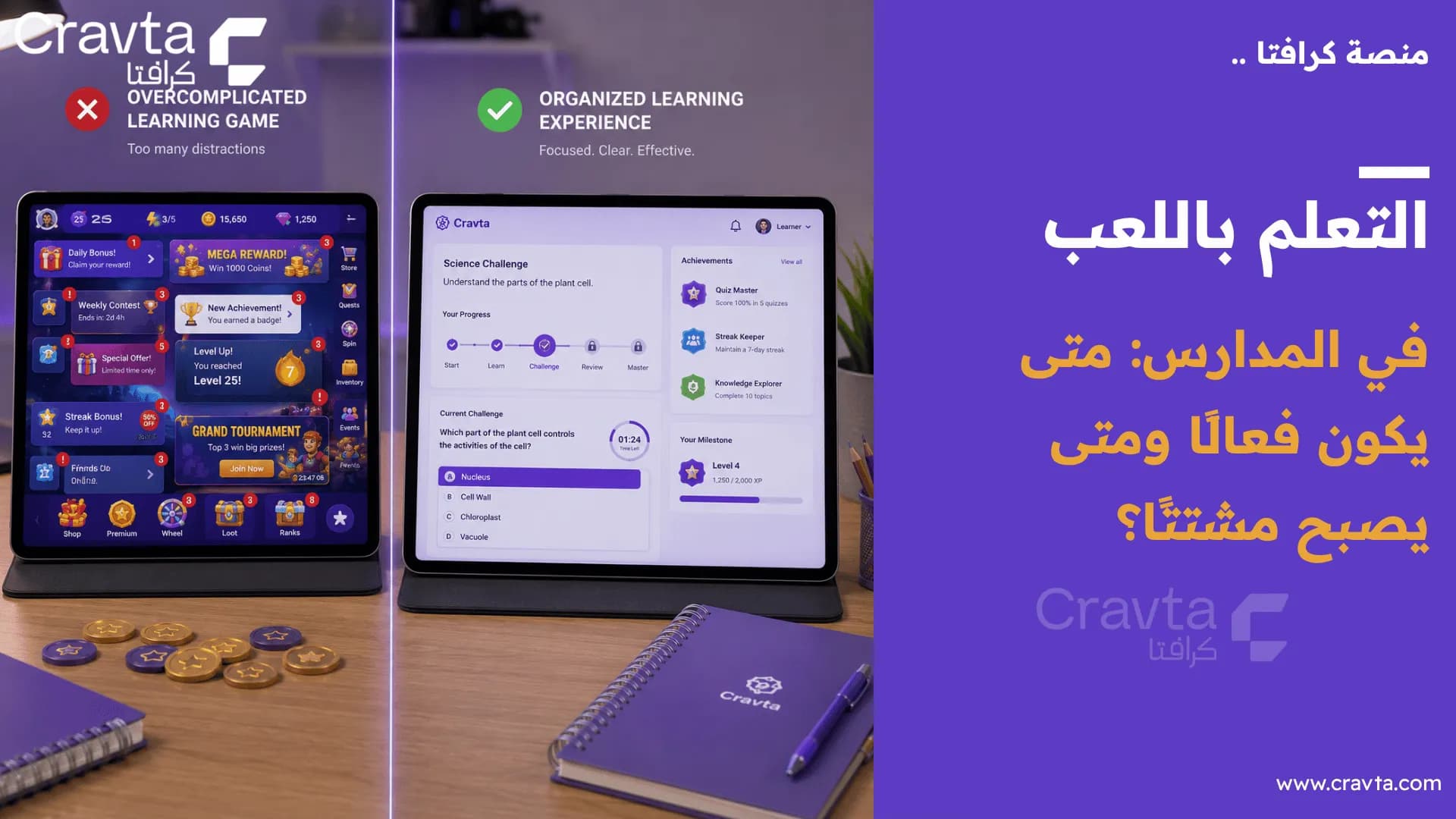
Playful learning has become one of the methods that most attracts the attention of schools and teachers when searching for modern ways to make the class more fun and interactive. The idea seems very attractive: turning the lesson into an activity, challenge, and participation experience instead of just traditional explanation. But the important question here is not only: Is learning through play in schools useful? But also: When is this method truly effective, and when does it become a distraction that takes students away from the educational goal? Understanding this difference is necessary for every school or teacher who wants to use educational games in a correct way that serves learning and does not weaken it.
What is meant by playful learning?
Playful learning is an educational method that relies on the use of activities, games, or challenges linked to a clear educational goal, so that the student learns through participation, experience, and interaction. The idea here is not for the student to play simply for entertainment, but rather to use play as a means of understanding, confirming, or applying information.
Therefore, learning through play in schools is different from regular play, because it must be linked to:
Academic content
Educational goal
Directed activity
Follow up on understanding or performance
When educational games are used in this way, they can become a very powerful tool to support learning.
Why does learning through play work for so many students?
Learning through play succeeds because the student naturally interacts more with what feels like participation, movement, and accomplishment. When the lesson turns into an activity:
Challenge
Question
Specific time
Bonus
Positive competition
Clear progress
The student feels excited and becomes more ready to focus and interact. This is what makes interactive learning related to play more attractive than some traditional methods that rely only on reception.
When is gamified learning really effective?
Learning through play is effective when a number of basic conditions are met, the most important of which is that play is a means that serves the goal, and not that the goal is merely spending an enjoyable time in class.
It is effective when:
Be linked to a clear learning objective
It suits the age and level of students
Serves the lesson content directly
Helps to understand, review or apply
The teacher can notice its effect on the students
Increases interaction without interrupting the class sequence
When these conditions are met, simple educational games turn into a powerful tool that increases understanding and attention and supports learning outcomes.
When does learning through play become distracting?
On the other hand, learning through play in schools may turn into a distracting method if used in an ill-considered manner. Not every classroom game is a successful education, and not every fun activity achieves a good educational outcome.
Becomes distracted when:
It does not have a clear educational goal
It takes more time than its educational value
Focuses more on competition than understanding
It makes the student more concerned with winning than learning
It leaves no noticeable or measurable effect
Used randomly just to break the boredom
In this case, students may emerge from the activity excited, but with no real improvement in understanding or performance.
The difference between purposeful play and random play
To understand the success of playful learning, it is important to distinguish between two types:
First: purposeful play
It is a game that:
It is related to an academic goal
Measures a skill or concept
Helps interaction and understanding
It gives the teacher an opportunity to observe and evaluate
Second: random play
It is a game that:
It is not clearly related to the lesson content
Focuses on enthusiasm only
It does not provide followable educational value
It may consume class time for no real benefit
This difference is very fundamental, because the success of interactive learning is not based on introducing play only, but rather on directing play within the educational process correctly.
What is the role of the teacher in the success of learning through play?
The teacher is the most important element in the success of playful learning in schools, because he is the one who determines:
When to use the activity
What is the purpose of it?
How to connect it to the lesson
How to explain the rules
How to balance fun and discipline
How to notice the effect of activity on understanding
Even the best educational toys can lose their value if they are not used at the right time or in the right way. Therefore, the role of the teacher is not only to implement the activity, but to guide it educationally.
Is learning through play suitable for all subjects?
Yes, learning through play can be used in many subjects, but to different degrees and methods. For example:
In mathematics, quick challenges and direct questions can be used
In language, cards, flash cards, and vocabulary can be used
In science, classification games, experiments and tasks can be used
In studies the order of events or knowledge puzzles may be used
So, the idea does not depend on a specific material, but rather on the way the activity is designed and how it relates to the content.
How does the school know that play actually serves learning?
The important question here: How does the school or teacher ensure that learning through play does not turn into distraction?
This can be known through indicators such as:
Did the students understand the concept required after the activity?
Did more students participate?
Did you see better results in questions or review?
Did the activity help confirm the information?
Was the teacher able to monitor the students’ level after him?
If the answer is yes, then the play was purposeful, not just a way to fill class time.
Where does Cravta appear in this context?
When talking about learning through play, it is important to point out that the real value is not only in the presence of points or competition, but in linking these elements to measuring understanding and improving performance. Here, Cravta can be mentioned as an example of the idea of purposeful play, because gamification within it is not based on formal stimulation only, but is also linked to:
Questions
Challenges
Tests
Reports
Performance follow-up
Measure interaction and understanding
This makes Cravta an example of how gamified learning in schools can turn into a measurable learning experience, not just a points system and competition with no clear impact.
Why does learning through play need to be measured?
One of the biggest mistakes is to use gamified learning as merely an encouragement tool. It is true that the school and the teacher need to know:
What did the student learn?
What did he understand?
Where did he go wrong?
How to improve?
What skills need additional support?
Therefore, the presence of tools that help measure the impact of educational games in the classroom makes this method more valuable and more professional in application.
How does school balance fun and discipline?
One of the most important reasons for the success of learning through play is balance. The school does not want the class to turn into aimless play, and it also does not want it to remain static without interaction. The solution is in:
Determine a clear goal for each activity
Set time
Explain the rules simply
Link the activity to an educational outcome
Use stimulation without exaggeration
Review the impact of the activity after its completion
The more this balance is achieved, the more effective and stable interactive learning becomes within the school.
Conclusion
Playful learning represents an important opportunity for schools and teachers to make the class more interactive, fun and relevant to the student, but it does not automatically succeed simply by introducing a game or challenge into the classroom. Real success happens when you play:
Purposeful
Related to the content
observable
Supported by monitoring and measurement
Therefore, playful learning in schools is effective when it serves understanding and application, and becomes distracting when it turns into an activity separate from the educational goal. Hence the importance of solutions that support purposeful play, such as Cravta, where gamification is linked to measuring understanding, reporting, and tracking performance, and not simply collecting points or creating a formal competition.
Frequently asked questions
What is meant by playful learning?
Playful learning is the use of activities and games linked to a clear learning objective to help students understand, engage and interact.
Is playful learning suitable for schools?
Yes, if used in an organized and content-related manner, it helps increase engagement and improve understanding within the school.
When is gamified learning effective?
It is effective when it serves a clear learning purpose, is relevant to the lesson, and its impact on understanding or performance can be observed.
When does learning through play become distracting?
When it is used without a clear purpose, focuses solely on enthusiasm and competition, or consumes class time without a real learning outcome.
What is the difference between purposeful play and random play?
Purposeful play is linked to content, a goal, and an educational outcome, while random play is an enjoyable activity, but it may not leave a real impact on learning.
How does Cravta relate to the idea of learning through play?
Cravta is linked to the idea of purposeful play, because gamification within it is tied to measuring understanding, reporting, and tracking performance, not just points or competition.
Explore these related topics: interactive educational games, types of educational games, gamification in education.
You may also like
Interactive educational games in the classroom: 10 workable ideas
Types of educational games: How do you choose the appropriate activity according to the age of the student and the goal of the lesson?
Gamification in education: A practical explanation for schools and teachers
Your next step: Learn more about the Cravta learning platform, browse Cravta articles, then create your account to build a more interactive learning experience.