Gamification in education: A practical explanation for schools and teachers
ففريق كرافتا··8 min read
Gamification in education has become one of the most talked about concepts in developing schools and raising student engagement, but many teachers and administrations still wonder: What does it mean in practice? Is it just adding points and rewards within the class? Or is it a deeper educational method than that? The truth is that gamification in education is not just a way to make the class fun, but rather a structured way to transform learning into a more engaging and motivating experience, through the use of elements taken from the world of games within the educational environment. When used correctly, it helps raise enthusiasm, improve engagement, enhance understanding, and support clearer performance monitoring.
What is meant by gamification in education?
Gamification in education can be defined as the use of game elements within the educational process with the aim of increasing student motivation and raising the level of interaction and participation. These elements may include:
Points
Badges
Levels
Challenges
Leaderboards
Rewards
Interim progress
But what is important here is that these elements are not used merely for entertainment, but rather to serve a clear educational purpose. Therefore, the use of gamification in education differs from regular play, because the goal is to employ motivational tools within the lesson itself to support understanding, application, and continuation.
Why has gamification become important in schools?
Schools today face a clear challenge in maintaining students’ attention and motivation in class, especially with changing learning styles and the increased impact of the digital environment on students. Here comes the role of educational gamification, because it helps to:
Reducing boredom during class
Increase enthusiasm for participation
Encouraging students to progress
Promote continuity and discipline
Transforming learning into an experience that is more personal to the student
For this reason, gamification in education has become one of the trends most relied upon by schools that want to develop their educational environment without deviating from academic goals.
How does gamification work in the classroom in practice?
In order to understand gamification in education more clearly, it is useful to look at it from the perspective of application, not just definition. When a teacher explains a lesson, they can use gamification elements like this:
The student gets points when he completes an activity or answers correctly
Moves to a higher level after achieving a certain achievement
He gets a badge when he excels in a skill or participation
Participates in an individual or group challenge during the class
His rank appears on a leaderboard in a way that encourages him to advance
It is evaluated through interactive tests instead of the traditional method only
Here the lesson turns from a simple explanation into an experience that includes a path, achievement, follow-up, and motivation.
What is the difference between gamification and playing in the classroom?
It is very important to distinguish between gamification in education and simply introducing a game into the classroom. A casual game may be fun, but it does not necessarily achieve a clear educational goal. As for educational gamification, it is:
Organized
Related to the lesson
Measurable
Serves an educational purpose
Supports interaction and follow-up
In other words, using gamification in education does not mean that the classroom turns into an entertaining time only, but rather that the school uses the elements of play in an intelligent way that supports learning itself.
What are the practical benefits of gamification for teachers?
When a teacher applies gamification in education well, he not only achieves fun in the classroom, but also obtains practical benefits, such as:
Increase student participation rate
Attract the attention of weak students in interaction
Facilitating review and evaluation
Strengthening the spirit of positive competition
Improve discipline within the activity
Make the class more lively and easier to manage
Educational gamification also helps the teacher present content in a way that is closer to students’ understanding and interests, especially at stages that need constant stimulation.
What are the practical benefits of gamification for students?
The student, in turn, benefits from gamification in education because he feels that learning is no longer just a traditional duty, but rather an experience in it:
Challenge
Achievement
Advance
Share
Bonus
Clarity on the path
This makes the student:
More willing to participate
More willing to try
Less afraid of making a mistake
More relevant to the lesson
Therefore, using gamification in education helps improve the student’s psychological and educational experience at the same time.
When does gamification succeed in education?
Although educational gamification is important, its success does not come automatically. He succeeds when:
Be linked to a clear learning objective
It does not overwhelm the content itself
Suitable for the age of students
Be understandable and simple
It takes into account the balance between enjoyment and evaluation
Allows the teacher to monitor impact and results
However, if gamification is used randomly or excessively, it may turn into a distraction rather than a means of support.
What gamification elements are most used in schools?
The most widely used and successful elements of gamification in education are:
1) Points
The student earns it when he answers, participates, or completes, and it helps enhance progress.
2) Challenges
It makes the student more motivated, whether individually or collectively.
3) Leaderboards
Displays the rankings of students or teams, which supports positive competition.
4) Badges
It gives the student a feeling of accomplishment and distinction when achieving a specific goal.
5) Interactive assessments
They help measure understanding in a more dynamic and rapid way than traditional tests alone.
These elements are the basis of many Gamification in Education applications around the world.
Where does Cravta appear in practical application?
When explaining gamification in education in practical terms, Cravta can be cited as a clear example of a platform that systematically applies gamification within the educational environment. Crafta does not just display content, but rather employs elements of educational gamification through:
Points
Challenges
Leaderboards
Badges
Interactive assessments
This is very important, because the value of gamification is not only in adding an enjoyable form, but in linking these elements to an educational experience that can be monitored and measured. Therefore, Cravta can be viewed as a practical example of using gamification in education in a way that serves the student and the teacher at the same time.
Is gamification suitable for all subjects?
Yes, gamification in education can be applied in many subjects, such as:
Mathematics
Science
Arabic language
English language
Social studies
General skills
But the application method varies according to the material. In mathematics, quick challenges can be used, in language, cards and vocabulary challenges can be used, and in science, applied questions and classification and comparison activities can be used.
How does a school or teacher start implementing gamification?
If a school or teacher wants to start using gamification in education, it is best to start simple and organized, such as:
Choose one lesson
Define a clear goal
Add one or two gamification elements
Monitor student interaction
Evaluate the results
Gradually develop the experience
Success here does not require great complexity, but rather a good understanding of the idea of educational gamification and applying it in a thoughtful way.
Conclusion
Gamification in education represents one of the most important modern approaches that helps schools and teachers make learning more engaging, motivating, and clear. It is not based on playing just for fun, but on using elements such as points, challenges, leaderboards, badges, and interactive assessments to serve clear educational goals.
When gamification is used in education in a practical and organized manner, it contributes to raising enthusiasm, improving interaction, supporting understanding, and developing the student experience within the classroom. Hence the value of solutions that implement educational gamification in an integrated manner, such as Cravta, which employs points, challenges, leaderboards, badges, and interactive assessments to provide a more lively and measurable educational experience.
Frequently asked questions
What is meant by gamification in education?
Gamification in education is the use of gaming elements such as points, challenges, and badges within the educational process to increase engagement and motivation.
What is the difference between gamification and classroom play?
Gamification is linked to a clear educational goal and its impact can be measured, while regular play may be fun, but it does not always serve learning.
Is the use of gamification in education appropriate for schools?
Yes, if used systematically and linked to the content, it helps increase engagement and improve the learning experience.
What are the most important elements of educational gamification?
The most important are: points, challenges, leaderboards, badges, and interactive assessments.
Can gamification be applied in all subjects?
Yes, but the application method varies depending on the nature of the subject and the academic stage.
How does Cravta apply gamification in education?
Cravta applies gamification through points, challenges, leaderboards, badges, and interactive assessments within a structured learning environment.




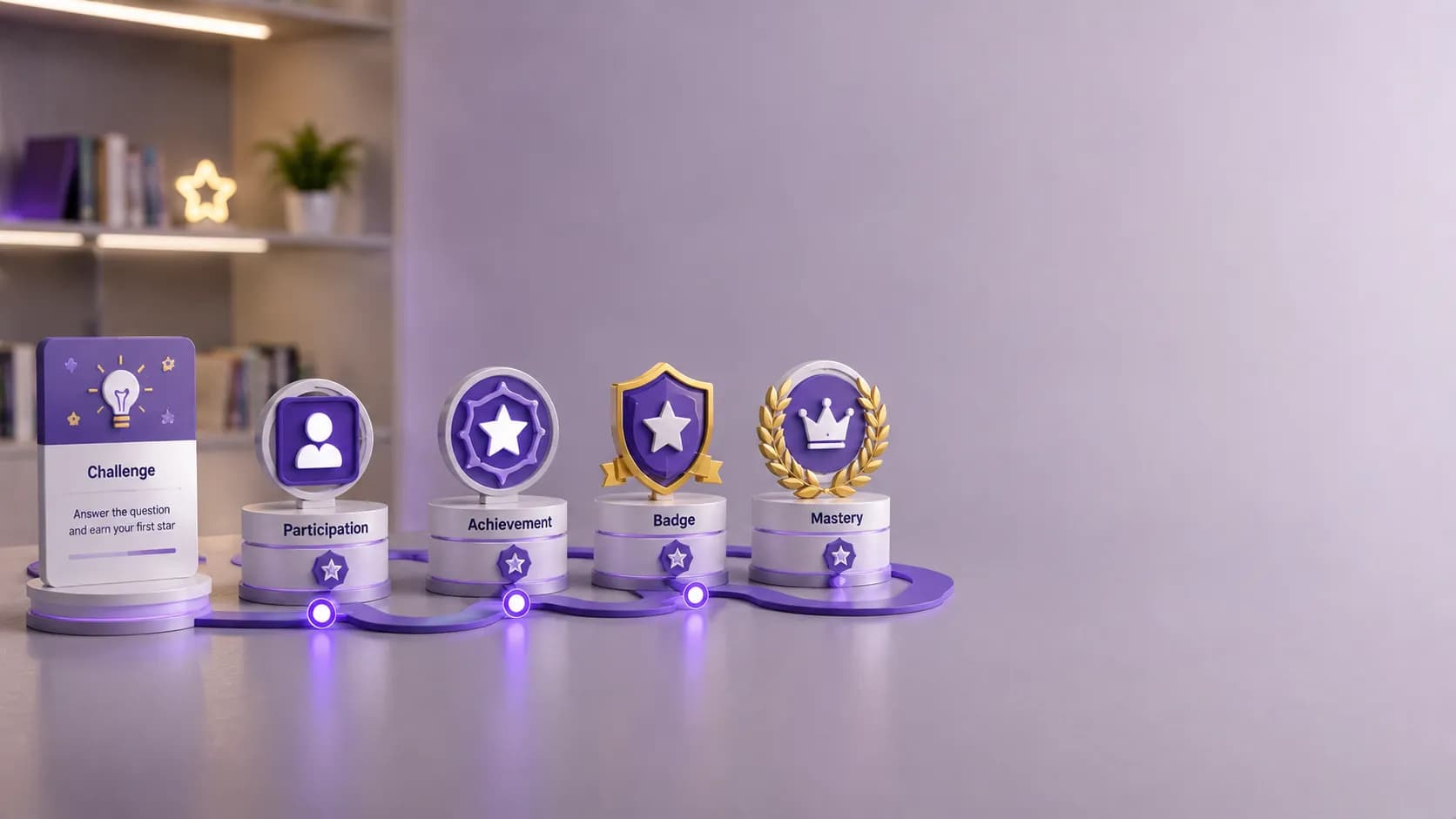
Gamification in education has become one of the most talked about concepts in developing schools and raising student engagement, but many teachers and administrations still wonder: What does it mean in practice? Is it just adding points and rewards within the class? Or is it a deeper educational method than that? The truth is that gamification in education is not just a way to make the class fun, but rather a structured way to transform learning into a more engaging and motivating experience, through the use of elements taken from the world of games within the educational environment. When used correctly, it helps raise enthusiasm, improve engagement, enhance understanding, and support clearer performance monitoring.
What is meant by gamification in education?
Gamification in education can be defined as the use of game elements within the educational process with the aim of increasing student motivation and raising the level of interaction and participation. These elements may include:
Points
Badges
Levels
Challenges
Leaderboards
Rewards
Interim progress
But what is important here is that these elements are not used merely for entertainment, but rather to serve a clear educational purpose. Therefore, the use of gamification in education differs from regular play, because the goal is to employ motivational tools within the lesson itself to support understanding, application, and continuation.
Why has gamification become important in schools?
Schools today face a clear challenge in maintaining students’ attention and motivation in class, especially with changing learning styles and the increased impact of the digital environment on students. Here comes the role of educational gamification, because it helps to:
Reducing boredom during class
Increase enthusiasm for participation
Encouraging students to progress
Promote continuity and discipline
Transforming learning into an experience that is more personal to the student
For this reason, gamification in education has become one of the trends most relied upon by schools that want to develop their educational environment without deviating from academic goals.
How does gamification work in the classroom in practice?
In order to understand gamification in education more clearly, it is useful to look at it from the perspective of application, not just definition. When a teacher explains a lesson, they can use gamification elements like this:
The student gets points when he completes an activity or answers correctly
Moves to a higher level after achieving a certain achievement
He gets a badge when he excels in a skill or participation
Participates in an individual or group challenge during the class
His rank appears on a leaderboard in a way that encourages him to advance
It is evaluated through interactive tests instead of the traditional method only
Here the lesson turns from a simple explanation into an experience that includes a path, achievement, follow-up, and motivation.
What is the difference between gamification and playing in the classroom?
It is very important to distinguish between gamification in education and simply introducing a game into the classroom. A casual game may be fun, but it does not necessarily achieve a clear educational goal. As for educational gamification, it is:
Organized
Related to the lesson
Measurable
Serves an educational purpose
Supports interaction and follow-up
In other words, using gamification in education does not mean that the classroom turns into an entertaining time only, but rather that the school uses the elements of play in an intelligent way that supports learning itself.
What are the practical benefits of gamification for teachers?
When a teacher applies gamification in education well, he not only achieves fun in the classroom, but also obtains practical benefits, such as:
Increase student participation rate
Attract the attention of weak students in interaction
Facilitating review and evaluation
Strengthening the spirit of positive competition
Improve discipline within the activity
Make the class more lively and easier to manage
Educational gamification also helps the teacher present content in a way that is closer to students’ understanding and interests, especially at stages that need constant stimulation.
What are the practical benefits of gamification for students?
The student, in turn, benefits from gamification in education because he feels that learning is no longer just a traditional duty, but rather an experience in it:
Challenge
Achievement
Advance
Share
Bonus
Clarity on the path
This makes the student:
More willing to participate
More willing to try
Less afraid of making a mistake
More relevant to the lesson
Therefore, using gamification in education helps improve the student’s psychological and educational experience at the same time.
When does gamification succeed in education?
Although educational gamification is important, its success does not come automatically. He succeeds when:
Be linked to a clear learning objective
It does not overwhelm the content itself
Suitable for the age of students
Be understandable and simple
It takes into account the balance between enjoyment and evaluation
Allows the teacher to monitor impact and results
However, if gamification is used randomly or excessively, it may turn into a distraction rather than a means of support.
What gamification elements are most used in schools?
The most widely used and successful elements of gamification in education are:
1) Points
The student earns it when he answers, participates, or completes, and it helps enhance progress.
2) Challenges
It makes the student more motivated, whether individually or collectively.
3) Leaderboards
Displays the rankings of students or teams, which supports positive competition.
4) Badges
It gives the student a feeling of accomplishment and distinction when achieving a specific goal.
5) Interactive assessments
They help measure understanding in a more dynamic and rapid way than traditional tests alone.
These elements are the basis of many Gamification in Education applications around the world.
Where does Cravta appear in practical application?
When explaining gamification in education in practical terms, Cravta can be cited as a clear example of a platform that systematically applies gamification within the educational environment. Crafta does not just display content, but rather employs elements of educational gamification through:
Points
Challenges
Leaderboards
Badges
Interactive assessments
This is very important, because the value of gamification is not only in adding an enjoyable form, but in linking these elements to an educational experience that can be monitored and measured. Therefore, Cravta can be viewed as a practical example of using gamification in education in a way that serves the student and the teacher at the same time.
Is gamification suitable for all subjects?
Yes, gamification in education can be applied in many subjects, such as:
Mathematics
Science
Arabic language
English language
Social studies
General skills
But the application method varies according to the material. In mathematics, quick challenges can be used, in language, cards and vocabulary challenges can be used, and in science, applied questions and classification and comparison activities can be used.
How does a school or teacher start implementing gamification?
If a school or teacher wants to start using gamification in education, it is best to start simple and organized, such as:
Choose one lesson
Define a clear goal
Add one or two gamification elements
Monitor student interaction
Evaluate the results
Gradually develop the experience
Success here does not require great complexity, but rather a good understanding of the idea of educational gamification and applying it in a thoughtful way.
Conclusion
Gamification in education represents one of the most important modern approaches that helps schools and teachers make learning more engaging, motivating, and clear. It is not based on playing just for fun, but on using elements such as points, challenges, leaderboards, badges, and interactive assessments to serve clear educational goals.
When gamification is used in education in a practical and organized manner, it contributes to raising enthusiasm, improving interaction, supporting understanding, and developing the student experience within the classroom. Hence the value of solutions that implement educational gamification in an integrated manner, such as Cravta, which employs points, challenges, leaderboards, badges, and interactive assessments to provide a more lively and measurable educational experience.
Frequently asked questions
What is meant by gamification in education?
Gamification in education is the use of gaming elements such as points, challenges, and badges within the educational process to increase engagement and motivation.
What is the difference between gamification and classroom play?
Gamification is linked to a clear educational goal and its impact can be measured, while regular play may be fun, but it does not always serve learning.
Is the use of gamification in education appropriate for schools?
Yes, if used systematically and linked to the content, it helps increase engagement and improve the learning experience.
What are the most important elements of educational gamification?
The most important are: points, challenges, leaderboards, badges, and interactive assessments.
Can gamification be applied in all subjects?
Yes, but the application method varies depending on the nature of the subject and the academic stage.
How does Cravta apply gamification in education?
Cravta applies gamification through points, challenges, leaderboards, badges, and interactive assessments within a structured learning environment.
Explore these related topics: interactive educational games, learning through play, types of educational games.
You may also like
Interactive educational games in the classroom: 10 workable ideas
Playful learning in schools: When is it effective and when is it distracting?
Types of educational games: How do you choose the appropriate activity according to the age of the student and the goal of the lesson?
Your next step: Learn more about the Cravta learning platform, browse Cravta articles, then create your account to build a more interactive learning experience.